
Description
Presentation
Cats have one main blood group system named AB system with 3 types: blood type A which is the most frequent, blood type B and blood type AB. The presence of naturally occurring alloantibodies in type A and in type B cats requires that blood typing must be performed prior to ALL blood transfusions to avoid an acute haemotytic transfusion reaction. It is now well established that cats possess other blood group systems such as Mik antigen or other unknown systems.
According to recent publications, it is now highly recommended to perform a Crossmatch Test (XM) in cats before the first transfusion. Indeed, the new studies have shown incompatible XM before the first transfusion between cats having the same blood group due to natural antibodies. These studies also describe incompatible XM Tests few days after the first transfusion that was previously compatible using the same donor, demonstrating the existence of other blood group systems and strong allo-immunization.
Our technology
Our Feline XM Gel Test (major and/or minor) is based on an individual Gel Test microtube filled with a mixture of gel and specific feline Antiglobulin reagent that will detect the presence of immunoglobulins (IgG & IgM) and/or C3 components binding to the red blood cells surface. Our Gel Test XM Test will allow you to pick-up incompatibilities across all feline blood groups (A, B, AB, Mik and other unknown antigens…).
MATERIAL
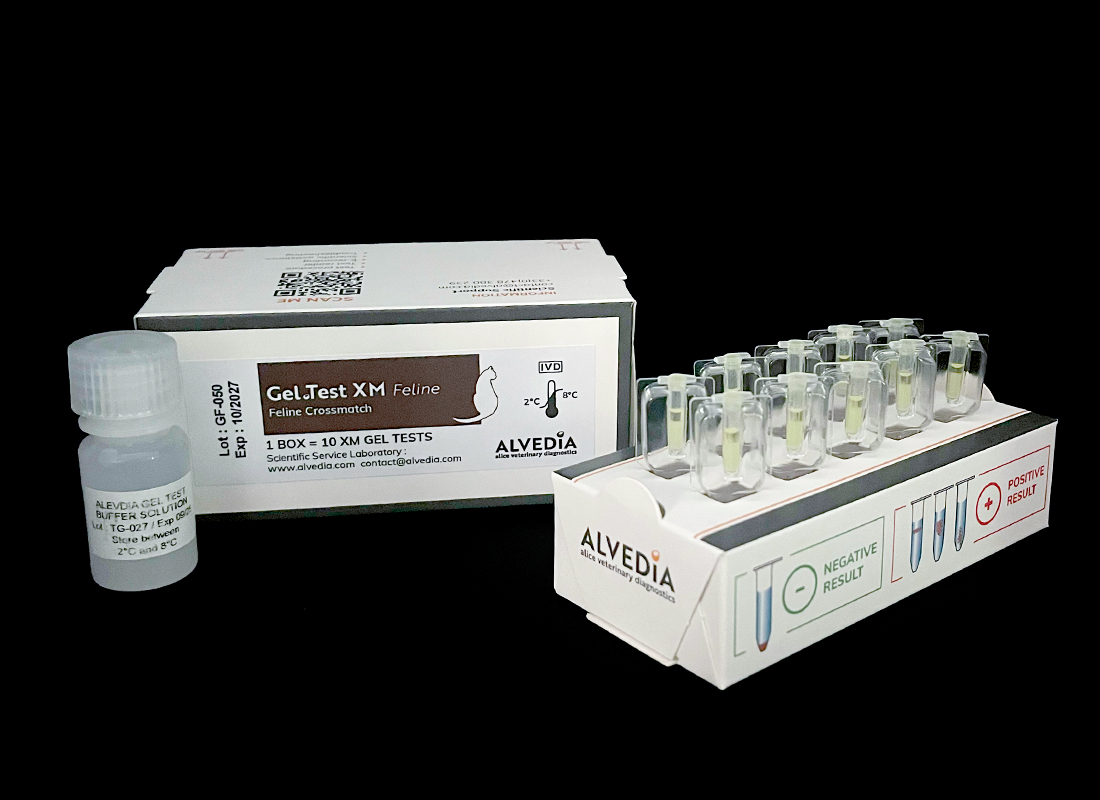
MATERIAL PROVIDED:
- 1 Box of 10 gel Tests
- 1 Buffer solution
GEL TEST PRODUCTS REQUIRE THE SPECIFIC CENTRIFUGE HETTICH EBA 270 OR DRUCKER TRUE BOND.
DO NOT PURCHASE THE CENTRIFUGE BEFORE ORDERING THE GEL TEST PRODUCTS.
Please contact us at contact@alvedia.com for more information regarding the purchase of the specific centrifuge.
User's guide
PRODUCT INFORMATION
Movie prodcedure
SCIENTIFIC INFORMATION & limitations
Scientific information:
- It is MANDATORY to blood type both the donor and the recipient for the AB blood group system before performing a Feline XM Test.
- This test allows detection of incompatibilities associated with the AB blood group system, Mik, Feline Erythrocyte Antigens (FEA), and other unidentified red blood cell alloantibodies.
- This test is used to detect alloantibodies after a mismatched transfusion or naturally occurring alloantibodies.
- Positive XM reactions may be observed in IMHA patients due to circulating autoantibodies present in the recipient plasma.
- Cats may rapidly develop alloantibodies following a transfusion. A XM is recommended before any transfusion, even if a previous transfusion was compatible.
- Test results must be interpreted in conjunction with the clinical and therapeutic context.
- The use of properly stored and well-preserved red blood cells is essential for reliable test performance and accurate result interpretation: samples showing hemolysis, bacterial contamination, or poor preservation may lead to inaccurate results.
- In Minor XM tests, weak false-positive reactions may occasionally occur when frozen-thawed donor plasma contains residual fibrin aggregates. If visible fibrin filaments are observed in the plasma sample, a centrifugation step is recommended.
Limitations:
- Blood bag segment stored for more than 7 days: wash 1 time in PBS or saline buffer (NaCl 0,9%) to obtain washed pRBCs.
- Do not use Gel Test tubes which show signs of drying.
- Gel Test tubes which show air bubbles or gel drops in the upper part of the tube must be centrifuged before use.
- Strict adherence to the procedures and recommended equipment, especially the Hettich EBA270 and Drucker True Bond, is essential for a reliable and validated result.
- A non-specific centrifuge (fixed angle centrifuge) will give you false positive results.
- Debris, fibrin residues or other artefacts may cause a few unagglutinated cells to trap on top of gel, but these should be interpreted as negative.
- Use of suspension solutions others than the provided one may modify the reactions.
- Too diluted or concentrated red blood cell suspensions can cause aberrant results.